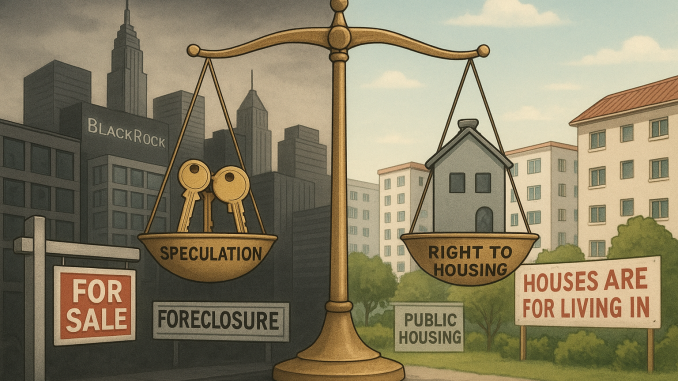
In the United States, we’re told we face a housing shortage. But walk through any city and you’ll see something else: vacant condos owned by shell companies, boarded-up rentals held off the market for speculation, and entire neighborhoods priced beyond reach. The problem isn’t supply—it’s ownership, purpose, and power.
Meanwhile, in China—a society often misrepresented in Western media—the challenge is nearly the opposite: a glut of unsold housing, built so rapidly that demand hasn’t caught up. Yet their response reveals a fundamental difference in priorities: when China’s housing bubble burst, the state protected people, not profits.
In 2016, President Xi Jinping declared: “Houses are for living in, not for speculation.” This wasn’t just a slogan—it became state policy. When China’s second-largest developer, Evergrande Group, collapsed under $300 billion in debt, the government did not bail it out. Instead, it let the company fail, fined its founder Hui Ka Yan, and banned him for life from capital markets. Once Asia’s richest man—worth $45 billion—Hui is now a mere multimillionaire. The losses were borne by those who profited from the bubble, not by workers, taxpayers, or the state.
Only after speculative prices crashed did China act to stabilize housing—not for investors, but for people. In 2024, the government committed $42 billion to buy unsold inventory at depressed prices and convert it into affordable housing. Combined with subsidies for young buyers, this approach de-financializes housing and treats it as a social good.
Compare this to the United States.
Here, “solutions” to the housing crisis often protect asset values, not residents. Take the recently floated idea of a 50-year mortgage, championed by Donald Trump and quietly explored by the Federal Housing Finance Agency. On paper, it lowers monthly payments. In reality, it’s a debt trap: a $500,000 home at 6% interest would cost over $1.5 million across five decades—with most early payments going entirely to interest. Worse, by making homes appear more affordable, such loans push prices even higher, benefiting sellers and banks while locking buyers into lifelong financial servitude. This isn’t relief—it’s financial engineering to preserve the bubble.
The same logic appears in local policy. In Seattle, governments are pledging hundreds of millions to buy properties at or near peak prices—even as population growth slows, homes sit unsold, and prices begin to fall. This isn’t affordability strategy; it’s a stealth bailout for landlords and developers just before a potential crash.
And a crash may be coming. After peaking in 2022, U.S. home prices are softening, inventory is rising, and sales are slowing—classic signs of a market rolling over.
Yet instead of doing what Keynes prescribed—holding public resources in reserve to spend during a downturn—the U.S. government is doing the opposite: it’s deploying public money now, at the top of the cycle. Whether it’s cities buying overpriced homes, floating 50-year debt instruments, or the federal government taking equity stakes in strategic firms like Intel and rare earth miners, the pattern is the same: using public funds to prop up private asset values just before they fall.
This isn’t prudent investment—it’s reverse Keynesianism: using the state to inflate bubbles rather than cushion their collapse.
The political winds, however, are shifting. In November 2025, Katie Wilson, a democratic socialist and lifelong renter, unseated Seattle Mayor Bruce Harrell on a platform of universal childcare, renter protections, and publicly funded affordable housing. Her victory reflects deep frustration with a system that serves speculators, not residents.
Yet even with the best intentions, her administration may face pressure to act now—buying distressed office buildings or rental portfolios at inflated valuations. If public funds are spent before prices correct, the result could mirror past failures: stabilizing private wealth while leaving working people behind. True affordability won’t come from buying at the peak—or from stretching debt across two generations. It will come from refusing to treat housing as a financial asset at all.
Meanwhile, giants like Berkshire Hathaway sit on $300 billion in cash, waiting to scoop up distressed assets after the fall—just as they did in 2008. The pattern is clear: private capital profits from boom and bust, while the public bears the cost.
This isn’t accidental. It reflects who holds power. In the U.S., corporate profit margins have soared—from around 10% a decade ago to 15% today. In China, most firms operate on margins of 1–6%, with profits actively constrained by the state. Why? Because China treats capital as a tool of national development, not an end in itself.
The U.S., by contrast, has surrendered economic sovereignty to asset managers like BlackRock, Vanguard, and State Street—firms that collectively own ~24% of nearly every major corporation. They don’t need majority control to steer the economy; quiet coordination is enough. The government’s 10% stake in a company isn’t “public ownership”—it’s a seat at a table already dominated by finance.
We’re told this system is “free market.” But figures like Peter Thiel—who openly champions private monopolies—reveal its true nature: neo-feudalism dressed as innovation. It’s an aristocracy of billionaires who believe their wealth is divinely or genetically ordained, absolving them of responsibility to society or the planet.
China isn’t perfect—but it is grounded. Its leadership enforces discipline over capital, not the reverse. And in a world teetering on ecological and financial collapse, that discipline may be the last best hope for ordinary people.
So when we discuss “affordable housing” in the U.S., we must ask: Who really benefits? If we buy overpriced homes now, we’ll have no resources left to buy them cheaply after the crash. If we subsidize landlords or stretch mortgages to 50 years, we reinforce the very system that made housing unaffordable.
Instead, let’s learn from those who’ve dared to say: Housing is not a commodity. It’s a right. Or perhaps better said: “Houses are for living in, not for speculation.”
And let’s build a movement that treats it that way—above ground, in our own names, and without apology.
Bruce D. Wilkinson Jr. is a lifelong activist, school bus driver, and resident of Washington State. He writes from a commitment to land, community, and truth.
For more on China’s economic model, see the 14th Five-Year Plan on “Common Prosperity.”



Be the first to comment